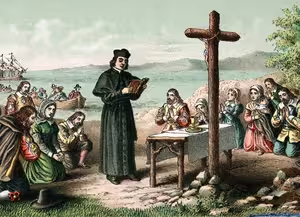

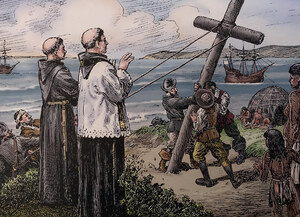
One of the biggest connections between religion and colonialism explored in the text is the way that Christianity is not only used as a spiritual system but as a classificatory tool used to racialize and dehumanize colonized peoples, justifying their dispossession and elimination. Omer and Lupo explain that religion, specifically Christianity, was entangled with the doctrine of discovery. This was a mechanism that coincided with the Spanish Inquisition and the discourse of blood purity. As the text discusses, during this period, colonizers “deployed a racialization logic to justify dispossession and elimination through conversion and other forms of death, including cultural and epistemic forms” (6-7). Religious identity became a sorting mechanism, “those with the 'correct' religion (Christians), 'incorrect' or ‘false’ religion (Muslims and Jews, or the two 'others' of Europe), and those deemed to have no religion and thus to be less than human and targets for colonial control, conversion, and liquidation” (7). What makes this connection even more compelling is the authors’ argument that this logic did not end with formal colonialism, it also persists through coloniality. Which is the power to define what counts as religion. They argue that following Talal Asad, is itself the power to control and contain people (6). By reinforcing that religion was a matter of specific beliefs, they could identify “key religious actors” within colonized communities to further “domesticate and fragment” them. This insight also reframes our understanding of contemporary politics. Nadia Fadil’s contribution discussed how Muslim communities in Europe are still subjected to the same classification logic through policies that single out Muslims by using religion and ideology. I agree with the authors’ statements that this is not a historical concept. As they stated, “the old did not go anywhere, nor is it dying” (5). Religion’s entanglement with colonialism continues to structure who is considered fully human and whose beliefs are treated as legitimate, and whose communities remain subject to surveillance.